





Pagination Catalog Software

Create print-ready InDesign and PDF product catalogs from PIM, ERP, DAM, or Excel data, with every language, market, and edition generated from one controlled workflow.


How Pagination Creates Your Catalogs

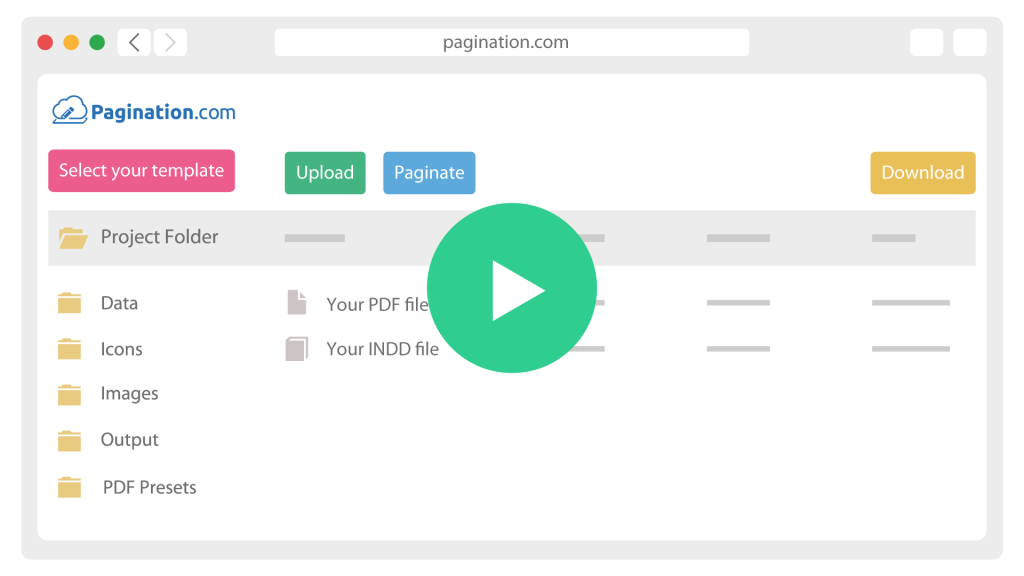
One workflow, repeatable on every export. No manual layout, no copying between files.

icon__custom-layout
1

Connect Your Data

Pagination reads from your PIM, ERP, DAM, or Excel, CSV, XML export.

icon__upload-data
2

Load Your Layout

Use your own InDesign layout, or start from one of our free catalog templates. Fields are mapped once, then reused on every export.

icon__paginate-document
3

Generate the Catalog

Pages, sections, indexes, tables, prices, images and translations placed automatically.

icon__download-files
4

Download Files

Native InDesign and PDF ready for press. Ready for print, distribution, or the web.

multilingual icon

Catalogs in Every Language

One product database, every language version generated automatically.  Pagination uses InDesign’s native dictionary engine with professional hyphenation in 40+ languages, so each translation flows correctly in the layout. No orphan lines, no broken tables.


Change a product description in your data source, every language version of the catalog reflects the change on the next run.

Catalogs at Any Scale

Pagination handles the same workflow for a 16 page seasonal lookbook or a distributor catalog of 5,000 pages with more than 100,000 SKUs. 


Structure generated from your data: sections, chapter breaks, table of contents, alphabetical indexes and product cross references are built from the data structure. Pages are never assembled by hand.

Automation that keeps the design

Pierre Frey, the Parisian maison of luxury home textiles founded in 1935, wanted to automate its catalogs without touching its editorial layouts.

Pagination automated its original InDesign templates: the annual catalog, thousands of sample labels and presentation decks are now generated from data, with pages that adapt to each product’s color variants

Inside Pagination Catalog Software: Features Built for Production

Production grade features for teams that publish catalogs as a core business process:

Automatic product data sync

Descriptions, specifications, assets and product attributes pulled from source on every run.

Hyphenation in 40+ languages

InDesign’s native dictionary engine hyphenates every translated edition correctly, with no orphan lines and no broken tables.

Market and customer specific editions

Generate catalog editions with different assortments, labels, languages, currencies and branding rules.

Smart layout adaptation

Images and text reflow per product automatically.

Sections, TOC and index generation

Built from the data structure, not by hand.

QR code and barcode generation

Optimized for print, embedded inline.

InDesign Book file support

Catalogs of thousands of pages, split into synced chapters.

Full API access

Trigger and integrate the workflow programmatically.

Cloud based

AWS EU infrastructure, GDPR compliant.

Works with the Systems You Already Use

Pagination connects to any source that exposes an API or a structured export such as Excel, CSV or XML. The systems below are only some examples, not a complete list.

PIM
Sales Layer Native
Salsify Native
Plytix Native
Akeneo Native
Pimcore
inRiver
Any other PIM, via API or export
ERP
SAP
Epicor
NetSuite
Infor
Oracle
Any other ERP, via API or export
ECOMMERCE
Shopify
Magento
WooCommerce
Any other e-commerce platform, via API or export
DAM
Bynder
Cloudinary
Any other DAM, via API or export

Frequently Asked Questions

What teams ask before automating their catalogs. Question not listed here? Ask our team.

Yes. Pagination automates your own InDesign templates without changing the design: Pierre Frey generates its annual catalog from its original editorial layouts. You can also start from one of our free catalog templates.

Any source that exposes an API or a structured export: PIMs such as Akeneo, Pimcore, Salsify, Plytix and inRiver, ERPs such as SAP, NetSuite and Epicor, or a plain Excel, CSV or XML file.

Yes. Every language version comes from the same product data, with InDesign’s hyphenation in 40+ languages. A global footwear brand produces 12 multilingual catalogs this way.

From a 16-page seasonal lookbook to distributor catalogs of 5,000 pages with more than 100,000 SKUs. Long catalogs can be split into synced InDesign Book chapters.

Other Documents You Can Automate

The same engine, connected to the same data, generates every other document your teams publish.

Price lists rebuilt in one run every time prices change, for every currency, language and customer.

Dealer price books with collections, option tables and regional editions, in the design of your current book.

Technical and product data sheets for every SKU: hundreds of print-ready PDFs in a single run.

Branded, compliant fund fact sheets generated in bulk from Excel, XML or API data.

See How Your Catalog Can Be Automated

Fill in the form to watch two short demos, available right after you submit.

Pagination needs your contact information to contact you about its service. You may unsubscribe at any time.

Watch demo